(az) Sea Vegetables

By: Christy Morgan

Sea vegetables, also known as seaweed, are among the most nutritious foods available. Learn about some common varieties of seaweed with Christy Morgan. From wakame to dulse, Christy explains the differences in flavor and how to incorporate them into your culinary repertoire (see the related recipe, Orange Wakame Salad).

Find more Co+op Kitchen videos featuring information and easy recipes for making delicious meals at home, as well as handy hints from chefs and food enthusiasts who love sharing their passion for great food.

Video Transcript

Hi. My name is Christy Morgan. I'm known as the Blissful Chef. Today we're going to talk about seaweed or sea vegetables, which have more trace minerals than any other food. They vary from ocean to ocean.

Types of seaweed

Nori

The most commonly known one is nori, which you've seen wrapped in your sushi.

Kombu

Here we have kombu, which is also known as kelp. I use a 1-inch piece of this when I cook beans and when I cook grains to help aid in digestion and add trace minerals.

Dulse

Now we have dulse, which is a beautiful red sea vegetable that's one of my favorites. It does not require soaking, and it often comes in a condiment shaker at the local co-op.

Arame

Sea vegetables come dried, and some of them need to be reconstituted. Arame is an example of that. It has a stronger flavor than a lot of the other sea vegetables, so it's great for marinating and sauteing with other vegetables.

Wakame

Here we have wakame. It's often found in long strips, or sometimes it's in flakes. You've seen it in your miso soup, but today we're going to make a nice wakame orange salad with it.

You can watch that in another episode.

A little goes a long way. You actually don't need that much to get the health benefits. Just a tablespoon or two will do.

Be sure to store your dried sea vegetables or seaweeds in a mason jar or an airtight container.

I'm Christy for Co+op, stronger together.

Source: https://mycooprocks.coop/content/sea-vegetables/

(az) Mindless Veggie Snacking

By: Eve Adamson

I recently became a 40-something grandmother (surprise!) and having a toddler part-time around the house has been illuminating. I remember being a stressed-out young mom with a toddler, and despite my good intentions, I didn't always feed him the best foods. Sugar was off the list for the first two years and I always bought whole grains, but frankly, the one thing I didn't do was expose him to a lot of veggies. He didn't like them, and why incite a tantrum? Besides, I wasn't eating them very often myself.

Now that I’m older, wiser, and have succumbed to the more subtle charms (and nutritional benefits) of vegetables, I would hate to see my granddaughter follow the same habits. As an un-frazzled grandmother, I see opportunities for creating and reinforcing valuable eating habits that will stick with her for the rest of her life. It has become my new mission: Mission Vegetable.

“But what about fruit?” you might be thinking. “My kids eat fruit. Isn't that enough?” Of course your kids can get great nutrients from fruit, but fruit is easy. Who doesn't like fruit? Banana wheels, juicy strawberries, big green grapes, Clementine segments—not a hard sell. Although fruit is far superior to cookies or candy, it’s important to balance fruit with veggies, for different nutrients in a low-sugar package. Veggies can train a child’s palate to appreciate a wider range of tastes beyond “sweet.”

But vegetables take longer to love. Some kids may need multiple exposures before they are even willing to give veggies a taste. After that, they may need anywhere from 8 to 20 tries (research varies on this one) before they are willing to decide they like that taste. Even the most well-meaning parent can get discouraged after a few rejections. Besides, who wants to spend an afternoon cajoling a toddler to taste a rutabaga? I could name ten things in ten seconds that I’d rather do.

Isn’t it easier to break out the graham crackers and the chocolate milk?

Another barrier to veggie consumption is that vegetables don’t necessarily lend themselves to easy snacking, especially for toddlers. Veggies don’t just swim down the gullet like those little cheese-flavored fish crackers do. What kid wants to gnaw on a carrot or decide how best to eat a broccoli floret when there are Big Wheels to ride, baby dolls to feed, rocking horses to tame, and block towers to build? Who has time for all that chewing? A few fruit snacks, a swig from a juice box, and they’re good to go.

It would seem Mission Vegetable is doomed. But wait! I have an idea. It might even work to train our kids to eat more vegetables without too much inconvenience to them or us.

Three words: mindless veggie snacking.

We aren't supposed to eat mindlessly. We’re supposed to focus, Zen-like, on every sensation as we slowly savor our food (a technique surely invented by somebody who never had a toddler). The truth is, most of us eat mindlessly at least some of the time, whether at the computer, in front of the TV, while reading or talking on the phone or working through the lunch hour. Kids do it, too. How many toddlers do you see teetering around the playground clutching sippy cups and cereal bars? A lot, that’s how many.

So what if we combined mindless snacking with vegetables, transforming a formerly bad habit into a good one?

I had to try it, and here’s what I discovered: timing is everything. The trick is to catch kids in between those times when they are climbing to the top of the jungle gym or chasing the dog around the living room. The second they sit, after having worked up an appetite, that’s when you make your move. Here’s how to do it:

1. Veggie prep

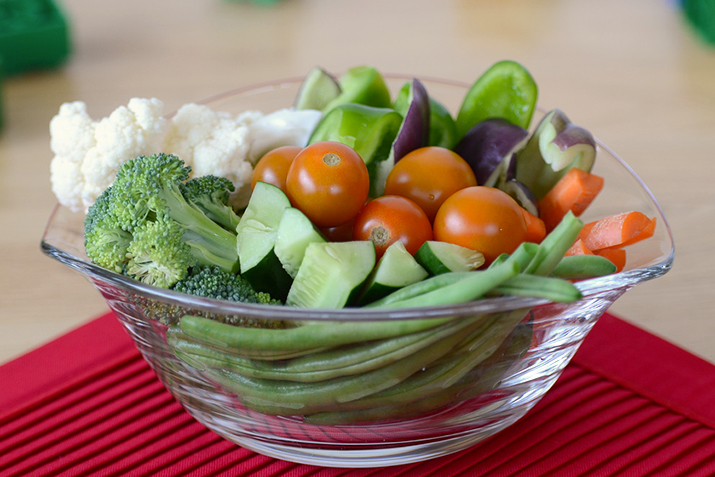
First, pick up some veggies—start with two or three varieties that taste good raw, and be sure to prepare enough for you and your youngsters. Some suggestions: grape tomatoes, broccoli and cauliflower florets, cucumber slices, carrot sticks, celery sticks, blanched green beans, pea pods, and every color of bell pepper strips.

2. Location, location, location!

Now, here’s the sneaky part. Watch them carefully. As soon as they flop down on the floor to play a board game, pet the cat, watch a video, or work on that Lego masterpiece, slyly place a bowl of veggies within arm’s reach, then slink away unnoticed, like a veggie ninja.

3. Up the ante

To make the veggies seem even more appealing, include one or two bowls of kid-friendly dip. My kids like hummus, Greek yogurt with garlic salt, salsa, and bean dip. My kids will eat an entire stalk of celery if it’s filled up with nut butter, and my granddaughter will eat just about anything if it’s dipped in queso (melted cheese dip). Hint: Serve on a tray or placemat, to avoid mess.

4. Healthy competition

Become the veggie bowl’s biggest fan. Look enraptured as you crunch on carrots or kohlrabi and make satisfied ‘yum yum’ noises. “Oh, you want the veggie bowl? I’m not sure I can part with it…but…well, okay. I’ll make the sacrifice for your happiness. It’s what moms do…”

Guess what: It works! At least, some of the time. And it’s easy. You’ll also feel like you've scored a major parenting coup when you witness your kids mindlessly filling their bellies with green beans and cauliflower and red pepper strips while they flip through board books or draw pictures of the dog. Next, they’ll start asking for more hummus, scrawling “broccoli” on the shopping list you keep on the refrigerator, and fighting over the last baby carrot. As I write this, my son is crunching on celery with peanut butter and my granddaughter is toddling around with a sippy cup, and guess what it’s full of? Peas. Yes, green ones!

Because the best part of mindless veggie snacking is that at some point, when they least expect it, kids are going to notice what they've been eating, and almost without meaning to, they’re going to notice that hey…they actually like vegetables.

Mission accomplished.
Source: https://mycooprocks.coop/article/mindless-veggie-snacking/

(az) A Forager’s Rolodex™

By: Joan Menefee

As a use of time and intellect, the forage is rigorous. When hunting for food is going badly, I see myself as one of those early humans whose genes did not persist—a dead ender. I don’t exactly feel grateful that I was born in an era of industrial food production or that I don’t have to learn whether or not urgency would lead to a sharp uptick in skill. But I do see how humanity developed such a love-hate relationship with the natural world, how our senses have developed in a very specific form of problem-solving, and how our leisure and play are still bound up with food.

In the United States, foraging is mostly a voluntary activity. I began as a child, picking blackberries at my great aunt’s farm. Little by little, I added foods to my repertoire: just call me tactile, curious, and hungry. Mulberries one year, chanterelles the next. Before I knew it, I was looking at all plant life as potential food. My husband has taught me (and this list really just skims the surface) that thimbleberries, wintergreen and wood sorrel are excellent trailside snacks, though the last should be taken in small doses as it contains an acid that can interfere with food digestion.

People sometimes purse their lips when they learn that I forage; they say, with something that is supposed to look like envy, “I wish I had time to do that.” This makes me feel like a sloth. And yet I have to wonder, like the author of a recent New York Times blog post, what the best way to spend time truly is. Foraging, in a world wildly out of touch with reality, seems like a good occupation. It reminds me of what people used to know. Trying to figure out when the black trumpets are going to flush this year has sensitized me to rainfall amounts (as full-blown drought has no doubt obsessed my neighbors in southern Wisconsin). I have also started noting the habits of other plant life, as I am always looking for signs that my favorite mushroom is out and the emergence of Indian Pipe seems to herald the arrival of trumpets.

Something Jared Diamond wrote in Guns, Germs, and Steel has stuck with me through the years. In a chapter that challenges stereotypical perceptions of hunter-gatherers, he writes, “The studies [of hunter-gatherers] generally show that such peoples are walking encyclopedias of natural history, with individual names (in their local language) for as many as a thousand or more plant and animal species, and with detailed knowledge of those species’ biological characteristics, distribution, and potential uses.” He goes on to tell a story about foraging with his research subjects in New Guinea, not as a matter of intellectual curiosity but in order to stay alive: after he expressed squeamishness about eating mushrooms they had offered, they “got angry and told me to shut up and listen while they explained some things to me.”

After years of hearing them recite the names of trees and plants, his informants wondered, how could Diamond believe they were ignorant of whether a certain mushroom was poisonous? Diamond’s description of his simple epiphany is touching for it reminds all of us that we sometimes process information in rigid and ridiculous ways. Diamond thought his informants knew only about things it occurred to him to ask them about, things which were obviously limited by the categories Diamond himself (a guy raised in Boston) applied to the world and environment. These “walking encyclopedias” were able to record and preserve information about the natural world in a way almost miraculous to those of us born in industrialized cultures. Perhaps brain studies, like those done on the Buddhist monks, should be done on foragers. My hunch is that similar patterns of brain stimulation would be revealed. Absorption is as absorption does.

But knowledge of the woods, knowledge of when and where certain plants flourish, and how to use them properly, is not miraculous. It is the product of focused effort, memory, analysis, and occasional creative verve. These are all things we peoples of industrialized economies could not see in hunter-gatherers for hundreds of years. What we need paper or electricity to maintain, others have held in their bodies. Like food itself, knowledge of food fuels cultures.

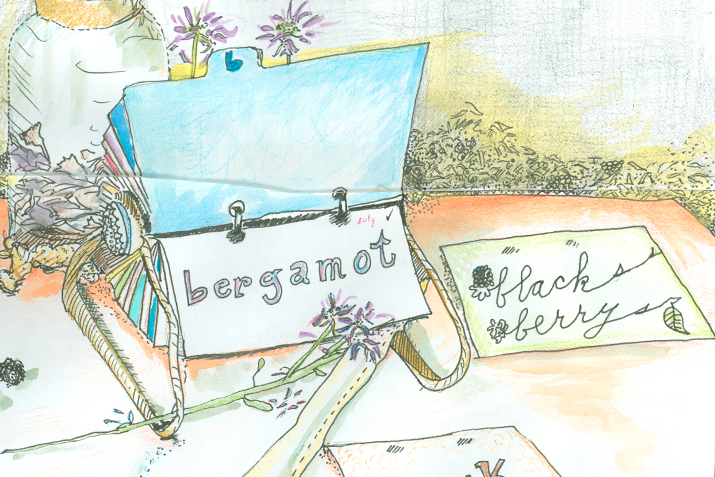
So my hunt for bergamot—a flower with notes of oregano and mint, and which makes a good infusion—may seem like a pretty filigree on a hot summer’s day. And indeed it is. But it is also part of the cataloguing, organizing, and orienting humanity has occupied itself with for ages.

Source: https://mycooprocks.coop/article/a-foragers-rolodex/

(az) Slow Cooker Chicken Cacciatore

By: Robin Asbell

Recipe Information

Total Time: 8 hours (1 hour active)

Servings: 6

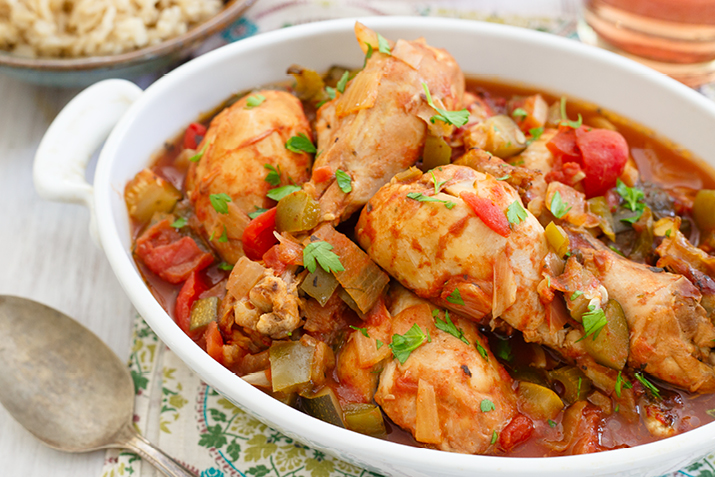
Chicken cacciatore is Italian for "hunter's chicken," and it's a classic, simple way to prepare poultry. This version has added vegetables and makes use of inexpensive leg pieces, which stew to tender perfection in the slow-cooker. Serving the flavorful sauce over brown rice stretches the meat, and makes use of every drop of chickeny goodness.

Ingredients

  • 14 ounces diced canned tomatoes
  • 1 large onion, chopped
  • 1 medium green pepper, chopped
  • 1 medium zucchini, sliced
  • 2 ribs celery, chopped
  • 3 cloves garlic, chopped
  • 1 teaspoon dried basil
  • 1 teaspoon dried oregano
  • 1/2 teaspoon salt
  • 1/2 cup dry red wine
  • 1/2 cup chicken stock
  • 4 ounces tomato paste
  • 6 chicken legs, skinless
  • 2 cups brown rice

Preparation

  1. In a large slow-cooker, combine the tomatoes, onion, green pepper, zucchini, celery, garlic, basil, oregano, salt, red wine, chicken stock and tomato paste. Stir to mix, then add the chicken legs and press down to cover them with the vegetable and spice mixture as much as possible. Set the cooker on low and cook for 7 hours.
  2. Start cooking the rice about 45 minutes before the chicken is finished cooking.
  3. When chicken cooking is completed, taste and add salt and pepper as needed. Serve a cup of cooked brown rice in a wide bowl or pasta plate, with a chicken leg and vegetable sauce.

Nutritional Information

457 calories, 9 g. fat, 74 mg. cholesterol, 476 mg. sodium, 63 g. carbohydrate, 4 g. fiber, 25 g. protein

Source: https://mycooprocks.coop/recipes/slow-cooker-chicken-cacciatore/

(az) Smoky White Bean and Ham Soup

By: Co+op

Recipe Information

Total Time: 8 hours, 15 minutes; 20 minutes active

Servings: 4-6

This is one of our High Five recipes, made from five main ingredients or less. Simplify your life with more delicious High Five recipes.

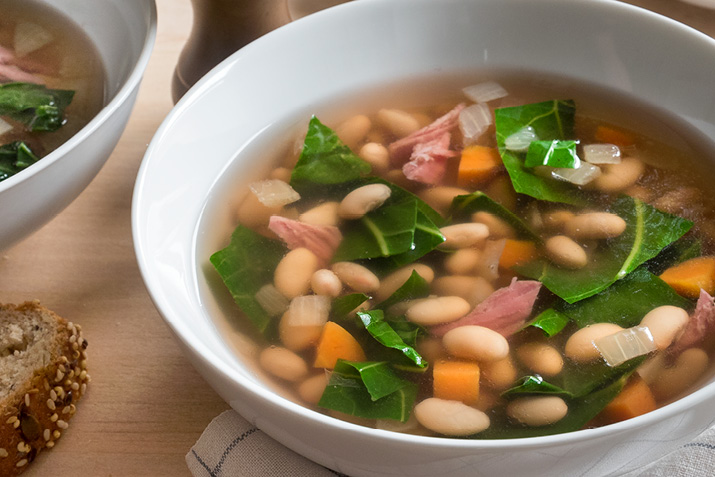
White beans are creamy and mild tasting, and they take on the smoky flavor of an inexpensive ham hock or turkey leg. It's a great way to make a little bit of meat flavor a whole pot of beans, providing all the protein you need.

Ingredients

The High Five

  • 1 cup navy beans, sorted and rinsed, soaked for at least 6 hours
  • 1 ham hock or smoked turkey leg
  • 1 large carrot, chopped
  • 1 medium onion, chopped
  • 1 bunch collard greens, chopped

Pantry and Kitchen Items

  • 6 cups water
  • 1 teaspoon dried thyme
  • 1/2 teaspoon red pepper flakes
  • 1/2 teaspoon salt

Preparation

  1. Combine the beans, water, ham hock or turkey leg, carrot and onion in a large pot. Over high heat, bring to a boil, then reduce to a simmer and cover with the lid slightly ajar. Simmer the beans for about an hour and a half. Add more water if the water level drops too low.
  2. Remove the ham hock or turkey leg and let cool, then pick off the meat, discarding the bone. Chop meat into small pieces and set aside.
  3. Add the collard greens, thyme, pepper flakes and salt to the pot and cover again for 30 minutes longer. The beans will be very tender and the greens soft. Stir in the reserved ham or turkey and simmer to heat through. Serve hot.

Serving Suggestion

Serve with a spinach salad and a slice of crusty whole wheat bread, for lunch or dinner.

Tips & Notes

For a vegan version, skip the ham and stir in a package of chopped smoky tempeh “bacon” after the greens are cooked, and heat through before serving.

Nutritional Information

530 calories, 25 g. fat, 75 mg. cholesterol, 410 mg. sodium, 44 g. carbohydrate, 17 g. fiber, 33 g. protein

Source: https://mycooprocks.coop/recipes/smoky-white-bean-and-ham-soup/

(az) Coconut Fudgesicles

By: Co+op

Recipe Information

Total Time: 30 minutes (plus freezing time); 10 minutes active

Servings: 6


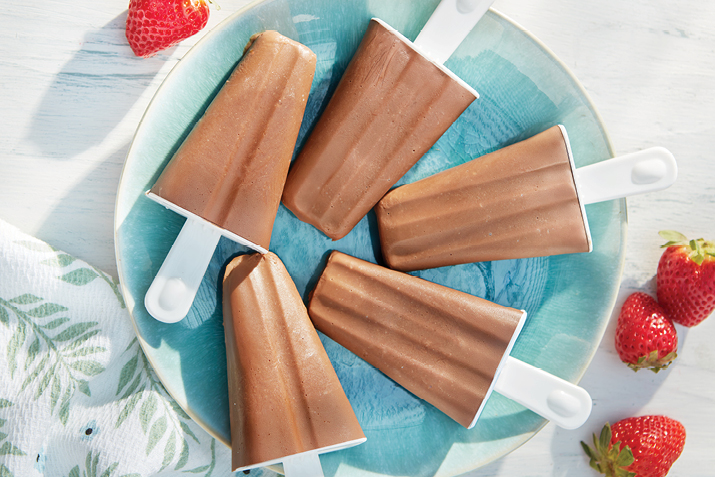
Cooling off on a hot day with a creamy fudgesicle is a joy of summer. Popsicle molds come in all kinds of shapes, and if you don’t want to buy a set, you can use three-ounce paper cups and your own wooden sticks. Make sure to clear a spot in the freezer so they have room to set level.


Ingredients

  • 1 15-ounce can coconut milk
  • 1/4 cup sugar
  • 2 tablespoons cocoa
  • 1 tablespoon arrowroot powder
  • 1/2 teaspoon vanilla


Preparation

  1. Whisk all the ingredients in a small pan and bring to a simmer over medium heat. When thickened and bubbling, after about 4 minutes, remove from heat and let cool. Pour the cooled mixture into molds and freeze for an hour or more before putting in the sticks.
  2. Freeze overnight and transfer the pops to a freezer bag when firm.


Serving Suggestion

Want to avoid a mess when serving these to little ones? Make a small hole in the middle of a cupcake/muffin liner and slide the popsicle stick through the hole. The liner will catch all the drips.


Nutritional Information


90 calories, 5 g. fat, 0 mg. cholesterol, 15 mg. sodium, 10 g. carbohydrate, 0 g. fiber, 0 g. protein


Source: https://mycooprocks.coop/recipes/coconut-fudgesicles/