Sure, you say. I’d like to have a garden, but I don’t have a yard, I only have a window ledge, and my thumb is anything but green. How can I grow vegetables?
Let me introduce you to the most determined vegetable of them all, the onion. Onions are members of the allium family which means they have a bulb, a handy little storage chamber at the base of the stem and it’s the secret to the onion’s invincibility. These plants have a life wish!
Think of all those onions that sprouted in the fridge or on the counter—they drew on their reserves to grow new leaves, and that pointy green sprout, as we know from eating scallions, is just as delicious as the bulb, and a lot easier to grow.
Onions are a wonderful mix of green vegetable and condiment. A sprinkling of chopped green onion boosts flavor, presentation and nutrition of everything from mashed potatoes to enchiladas and pad Thai. Fresh green onions provide vitamins A and C, iron, calcium and fiber.
So what do you need to get started growing these gems?
A pot at least 6 inches deep and as wide as your space allows
Good quality potting soil
A bunch of young green onions or a bag of pearl onions from your local food store
Selecting Your Onions: Two Options for Onion Greens
Green Onions
Young green onions are sometimes called scallions, spring or salad onions, and can be found with the lettuces in the produce section. They are whole young plants grown from seed and harvested just as their bulbs and leaves become juicy. Unlike the larger onions over there by the potatoes these have not been allowed to mature and dry out; they’re teenage onions. Their fat little white roots should still be attached. The longer and more intact these roots are the faster the onions will grow again. Before you plant them, cut off and use their long green tops—trimming their tops is important to encourage new growth. Just be sure not to cut down into the white bulb itself.
Pearl Onions
Pearl onions, also called boiler onions, are a bit of a gourmet item. These miniature dried onions are just an inch or two in diameter and are often used for creamed onions or for roasting with meat or new potatoes. They may be white, yellow or even red. They usually come packed twenty or so in a nifty little mesh bag, but you might also find them in bulk at a farmers’ market. These will take a little longer than green onions to get started as they have to grow new roots. But because their bulb is larger they have the potential to make a healthy show of greenery to harvest and enjoy. Their tops are pointed and their roots are a brushy dried stubble.
Planting
To plant your onions, fill the pot half full with moist soil. Then arrange the onion plants or bulbs two inches apart with the root side down. Gently but firmly pack more soil around them until the trimmed top of the green onion is just peeking out or the bulbs are completely covered. Water well and add more soil if it settles and exposes the bulbs. Place in a sunny window (onions need about six to seven hours of light per day) or under a grow light, and be patient.
Keep the pots moist and in a few weeks you will have a crop of green onion tops to harvest. Once harvested they will grow more green tops and you can harvest them again and again. In fact now that you know the trick you can start onion pots as gifts for all your friends!
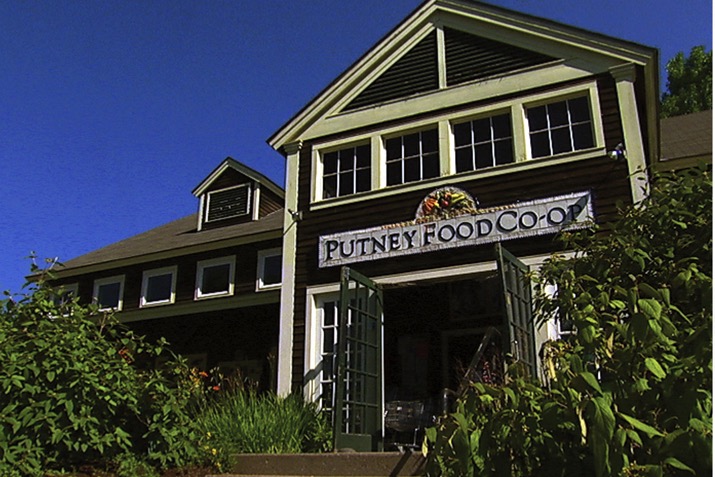
Putney Food Co-op (above) celebrated their 70th anniversary in 2012.
Cooperation is not new. Early human societies cooperated by sharing hunting, fishing, farming and shelter practices to improve their chances of survival.
Cooperatives began to take more formal shape in the late 18th century as people moved from farms to cities. No longer able to grow their own food, they relied on privately owned stores to provide nourishment. Often, the prices were high and the selection was limited.
As less powerful members of these new cities, the workers, consumers, farmers and producers banded together to gain economic clout. They improved their options through joint purchases of supplies and services, and kept their costs low. They answered to themselves, and when change was needed, it was made. They became a co-op—a business run by the people, for the people.
Want to take a deeper dive in to this history of co-ops? Read on or check out this video about the Rochdale co-op pioneers, commissioned for the Rochdale Pioneers Museum and Co-operative Heritage Trust.
A Deeper Dive into Co-op History
The following section was written by Karen Zimbelman, Development Director for National Co+op Grocers. Used by permission.
Early Co-op Origins
In early human societies, people learned to cooperate and work together to increase their success in hunting, fishing, gathering foods, building shelter, and meeting other individual and group needs. Historians have found evidence of cooperation among peoples in early Greece, Egypt, Rome, and Babylon, among Native American and African tribes, and between many other groups.
Early agriculture would have been impossible without mutual aid among farmers. They relied on one another to defend land, harvest crops, build barns and storage buildings, and share equipment. These examples of informal cooperation—of working together—were the precursors to the cooperative form of business.
The First Cooperatives
The earliest cooperatives appeared in Europe in the late 18th and early 19th centuries, during the Industrial Revolution. As people moved from farms into the growing cities, they had to rely on stores to feed their families because they could no longer grow their own food. Working people had very little control over the quality of their food or living conditions. Those with money gained more and more power over those without. Early co-ops were set up as a way to protect the interests of the less powerful members of society—workers, consumers, farmers, and producers.
In England consumers were frustrated by the abuses of store owners, many of whom adulterated products to increase their profits. In many cases, workers’ wages were paid in company chits—credit that could be used only at the company’s stores. The average consumer had very few choices and little control.
Groups of people began experimenting with various methods of providing for their needs themselves. They decided to pool their money and purchase groceries together. When they purchased goods from a wholesale dealer and then divided them equally among themselves, they were surprised at the savings and higher quality of products they were able to obtain.
The Rochdale Equitable Pioneers Society
In 1843 workers in the textile mills of Rochdale, England, went on strike. When the strike failed, the millworkers began to look for other ways to improve their lives. Instead of calling for another strike or asking charitable groups for help, workers decided to take control of one of the most immediate and pressing areas of their lives. They believed they needed their own food store as an alternative to the company store. Twenty-eight people founded the Rochdale Equitable Pioneers Society.
After saving money for more than a year, these pioneers opened their co-op store at 31 Toad Lane on a cold December evening in 1844. Although the founders agreed to sell just butter, sugar, flour, and oatmeal, they also offered tallow candles for sale that night. They were forced to buy candles because the gas company refused to supply gas for the new group’s lights. The founders bought candles in bulk and sold what they didn’t use to their members.
The Rochdale Pioneers weren’t the first group to try forming a co-op, but they were the first to make their co-op succeed and endure. To avoid the mistakes made by earlier co-op societies and to help others, they developed a list of operating principles governing their organization. This list formed the basis for what are now known as the cooperative principles. Rochdale is considered the birthplace of the modern cooperative movement.
Cooperation Grows in the United States
In the United States, cooperatives of one sort or another have roots going back to colonial times. Like their counterparts in England, these early groups experimented with ways to band together and gain economic clout.
From colonial times on, most early American co-ops were formed primarily for the benefit of farmers. Some co-ops helped farmers keep their costs low through joint purchases of supplies, such as feed, equipment, tools, or seed. Some marketing co-ops helped farmers obtain the best prices for their goods by combining their crops and selling in large quantities. Others, such as grain elevators or cheese-making co-ops, provided storage or processing services.
Consumer groups in the United States began taking note of the early British consumer co-ops and the success of American farmers who worked together. They began forming consumer protection associations.
Most early American co-ops failed due to insufficient capital (money invested by the owners), poor management, and a lack of understanding of the cooperative principles by their members. It wasn’t until the early 1900s that co-ops began to have true, long-lasting success in the United States.
Consumer Co-ops Make Waves
In rural and urban areas alike, consumer co-ops were first organized to provide consumers with control and to fight the unfair practices of private and company stores. Over the years, consumer co-ops have experienced waves of growth and development, followed by periods of decline.
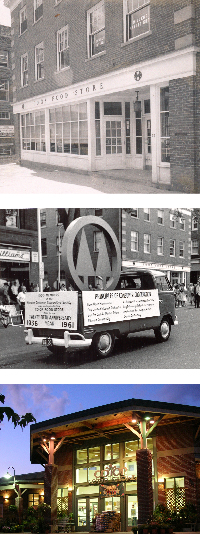
The Hanover Co-op: Co-op Food Store, Then and Now: Hanover’s first store on Main Street in Hanover, NH, in 1936 (top); Co-op Food Store celebrates its anniversary in 1961 (middle); Co-op Food Store, Lebanon, NY, in 2012, one of five co-ops in the Hanover Consumer Cooperative Society.
The first of these waves began in the early 1900s with what was called the Rochdale plan. Under this plan, consumers organized buying groups to purchase from a cooperatively owned wholesaler. The wholesaler would then gradually help these buying clubs convert their operations into retail outlets by supplying management, inventory, and capital. In 1920 there were 2,600 consumer co-ops in the United States—all but 11 were general stores—and 80 percent were in towns with populations of less than 2,500. Combined sales volume for these stores was about $260 million. Unfortunately, when the wholesalers began having problems due to rapid growth, the whole system crumbled, and most co-ops were closed within the decade.
The Great Depression of the 1930s triggered another great wave of co-op organizing in cities and rural areas.
Franklin Roosevelt’s New Deal supported the growth of urban co-ops. Some leading consumer co-ops were launched in this period—in Berkeley, Palo Alto, Eau Claire (Wisconsin), Hanover (New Hampshire), Hyde Park (a Chicago neighborhood), and Greenbelt (Maryland—a suburb of Washington, D.C.). All of these stores survived to their 50th anniversaries. But in the 1980s, the co-ops in Berkeley and Greenbelt closed. The Palo Alto Co-op closed in 2001. The co-ops in Hanover, Eau Claire, and Hyde Park continue to operate to this day.
In the late 1960s and 1970s, the “new wave” of consumer co-ops began. Born out of the ideas and philosophies of the 1960s counterculture, these stores were opened by young and idealistic members. They set up co-ops to fit their beliefs in equality, not to follow their co-op predecessors. Most of the new co-ops sold only whole, unrefined, and bulk foods. Their operating practices were diverse and experimental. Some stores had limited store hours, others were open seven days a week. Some were run by volunteers, others by fully paid staff. Some had various forms of worker self-management, others had more traditional management structures. Some paid year-end patronage refunds, others gave members a discount at the cash register.
These co-ops were pioneers in what came to be known as the natural foods industry. But not all were successful. Some failed because of their experimental structures and operating systems. Most were unable to escape the same problems that had troubled older, earlier co-ops—insufficient capital, inadequate membership support, an inability to improve operations as the natural foods industry developed, a stronger commitment to idealism than to economic success, the lack of adequate support from their wholesalers, and resistance to consolidation. But the “new wave” co-ops that survived are strong and well established. The consumer co-op movement in the United States has had mixed success—especially in contrast to consumer co-ops in Europe and Asia. But each wave of cooperative growth produces renewed enthusiasm for a time-tested idea and innovations that prove successful in the consumer marketplace.
Just like organic vegetables and buying in bulk, for many food co-ops, environmental sustainability in how they operate is not a new idea. Hunger Mountain Coop, a community-owned natural foods cooperative in Montpelier, Vermont, is exemplary for its long-term commitment to running a sustainable store.
For the past forty-three (and counting) years, Hunger Mountain has considered the environmental impact of their business decisions and operations. “We don’t have something we call an official ‘sustainability program,’ really, those considerations have just always been a part of the co-op’s DNA,” says Mary Mullally, Hunger Mountain’s Facilities Manager. This informal commitment is nonetheless evidenced by the store’s recognition as a Vermont Green Grocery Environmental Leader, which means they have been chosen by the state as a an example of a business that goes beyond compliance with existing environmental regulations, using resource conservation strategies and implementing environmental best management practices.
In recent years, the co-op has made some innovative improvements in energy efficiency by targeting refrigeration and HVAC systems. According to the Environmental Protection Agency (EPA), addressing refrigeration efficiency is the most important thing a supermarket can do to improve their environmental impact. The co-op has reduced their need for refrigerant in the winter by installing a system that cools walk-in coolers during the winter by circulating in cold air from outside. Additionally, they’ve installed a heat reclamation tank that captures heat from their refrigeration system to preheat hot water used on-site.
With the help of the non-profit Efficiency Vermont, the co-op conducted an energy audit, which resulted in additional ideas for improving their energy use. Efficiency Vermont provided recommendations and expertise about what government rebates might be available to offset the costs of upgrades or renovations. Results of the audit included replacing fluorescent lighting with LEDs and further improving refrigeration efficiency. Nonprofits similar to Efficiency Vermont exist in most states across the United States and can assist businesses with similar audits.
As of January, 2015, Hunger Mountain Coop began formally tracking sustainability metrics such as electrical and propane usage, compost, recycling and trash quantities through Co+efficient, a national sustainability program offered by National Co+op Grocers (the organization behind this website). “We’ve already found Co+efficient to be helpful, especially in that we’re able to compare our store to others. If we notice that our electrical usage seems high, we can compare with other similar-sized stores in our region and find out how they are addressing the same challenges.” says Mullally. “Now that we have a year’s worth of data, we look forward to referencing it as a tool to further guide our decisions.” Hunger Mountain plans to continue its forty-plus year commitment to energy efficiency by pursuing solar energy credits in the future.